
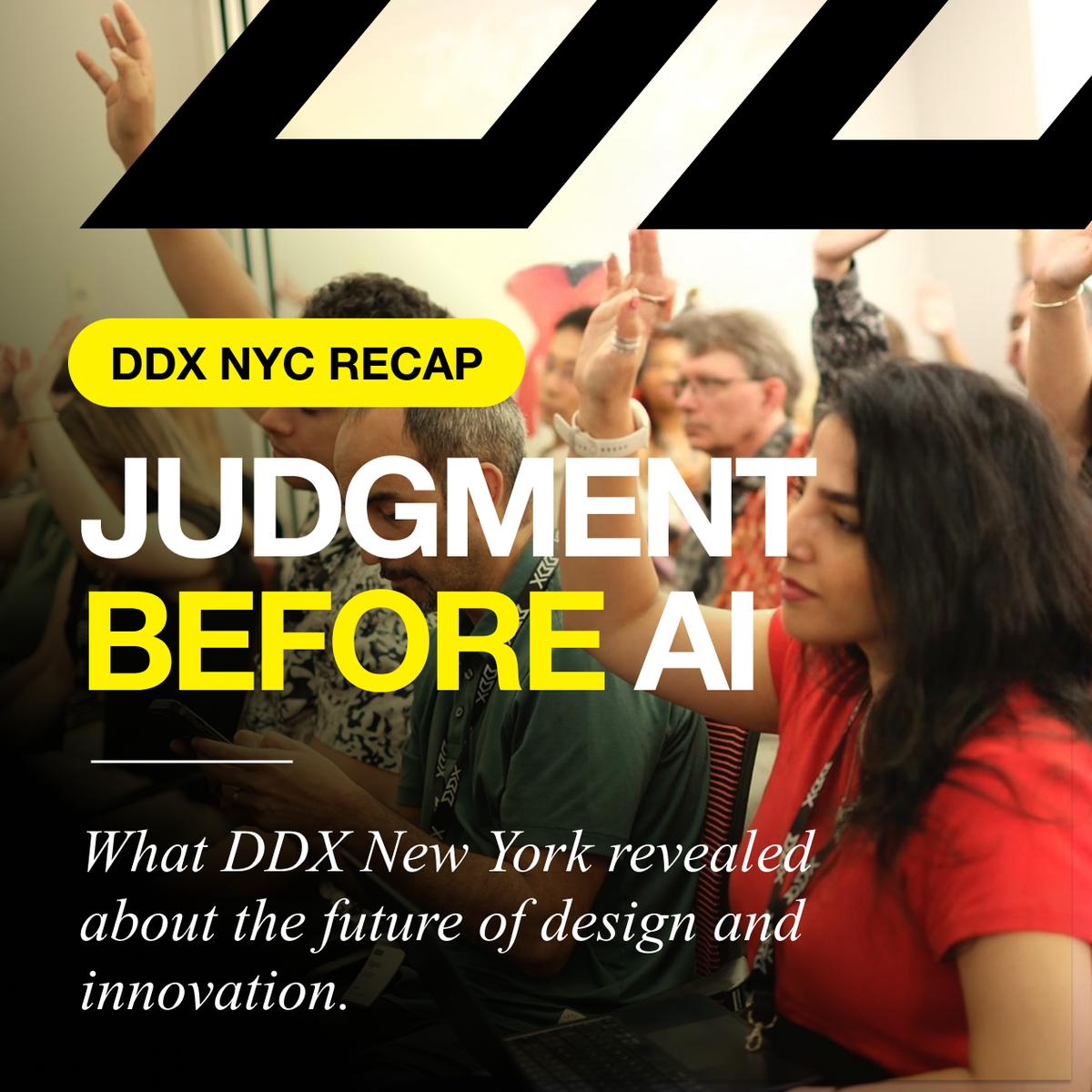
At DDX New York, the conversation around design, product and AI moved beyond the obvious.
It was not simply about whether artificial intelligence will change the way teams work. That question has already been answered. It was not about whether AI can generate, automate, summarize or accelerate. Those capabilities are already entering daily workflows. And it was not only about the next tool, interface or product feature.
The more interesting question running through the day was this:
What kind of judgment do design teams need now?
Across talks and panels with leaders from Bloomberg, Google, OpenAI, Amazon, Dropbox, Fable, Dscout, Walmart Global Tech, Fantasy, Edenspiekermann and others, a deeper pattern emerged. The future of design is not about making everything AI-first. It is about becoming more intentional about when to move fast, when to pause, when to test, when to include, when to automate, when to trust and when to say no.
In that sense, DDX New York was not only a conference about the future of design. It was a conference about the future of decision-making.
The Tactical Pause: Why Slowing Down Can Be a Leadership Move
In a year where almost every organization is trying to move faster, Ash Brown opened with a counterintuitive idea: sometimes design leadership means slowing the team down.
Her talk, "The Tactical Pause - When Design Leadership Means Slowing the Team Down," challenged one of the dominant assumptions inside modern product organizations. Speed is often treated as an unquestioned good. Teams are expected to ship, iterate, respond, align and adapt faster than ever before.
But speed does not always create progress.
Sometimes teams get stuck not because they lack talent, ambition or urgency, but because they are trapped in a loop. They continue debating the visible surface of a problem while losing connection to the deeper mission. A small design choice can become symbolic of much larger tensions. A team can keep moving without actually moving forward.
Ash's answer was not to stop forever. It was to pause tactically.
A tactical pause is not passive. It is not avoidance. It is a deliberate intervention that creates space for clarity. It asks teams to stop, consider and re-engage. It means defining the mission, resetting the mood, protecting the space, supporting investigation and communicating clearly as the work evolves.
That framing matters far beyond one team or one product. In an AI-driven environment, where more work can be produced more quickly, the ability to slow down becomes even more valuable. When output becomes cheap, clarity becomes expensive. When teams can generate dozens of options, the leadership challenge is no longer simply producing more. It is knowing what deserves attention.
The tactical pause reframes design leadership as the ability to create focus before execution.
Ash Brown — Global Head of UX, Enterprise Products & Data, Bloomberg
Sometimes teams get stuck not because they lack talent, ambition or urgency, but because they are trapped in a loop. They continue debating the visible surface of a problem while losing connection to the deeper mission. A small design choice can become symbolic of much larger tensions. A team can keep moving without actually moving forward. — Ash Brown
Evidence over Assumption: Why Teams Need to Test What People Actually Do
If Ash Brown's talk was about creating the space for better thinking, Harriet Swan's talk was about what should fill that space: evidence.
In "Why Guess When You Can Test?", Harriet Swan argued for a closer relationship between UX research and behavioral experimentation. The core idea was simple, but powerful: what people say and what people do are not always the same.
This is one of the oldest challenges in design and research, but it becomes more urgent in today's product environment. Teams are expected to make decisions faster. They are expected to justify those decisions with data. They are expected to understand customer behavior across increasingly complex journeys. Yet many organizations still separate research, analytics and experimentation into different silos.
Harriet's message was not that user research is wrong. It was that one method alone is limiting.
Research helps teams understand why people think, feel, and behave the way they do. Testing helps teams understand what actually happens in the real world. Together, they create a stronger decision system. Research without testing can over-rely on stated preference. Testing without research can optimize behavior without understanding meaning.
One of the most useful lessons from her talk was humility. A user insight can be true, while the first execution of that insight can still fail. That distinction is critical. Too often, teams treat a failed test as proof that an insight was wrong. In reality, it may simply mean that the idea was translated into the product in the wrong way.
That is a mature view of design work. It recognizes that insight is not the end of the process. It is the beginning of a learning loop.
For design leaders, this is a major shift. The question is not only, "Do we understand the user?" The question is, "Do we have a system that helps us keep learning from what users actually do?"
Harriet Swan — Director, UX Research, Gain Conversion
Accessibility is not a Constraint. It is where innovation often begins.
Victoria Bull's session, "The Accessibility Advantage," added another important dimension to the day: the future of design cannot be built around the average user.
Accessibility is still too often framed as compliance, risk mitigation or a specialized practice. Victoria challenged that framing directly. Her argument was that leading organizations treat accessibility as a driver of better customer experiences, product quality, efficiency, innovation, business growth and AI readiness.
That shift in language is important.
If accessibility is treated only as a legal or technical requirement, it arrives late. It becomes remediation. It becomes a checklist. It becomes something teams add after the important decisions have already been made.
But when accessibility moves earlier into discovery, strategy, design systems and product development, it changes the quality of the work itself.
The strongest idea from the session was that innovation happens at the edges. Many mainstream product improvements begin as solutions for people whose needs were previously underserved or misunderstood. Captions, text-to-speech and hands-free interaction are not only accessibility features. They are examples of how designing for specific human needs can create broader value for everyone.
This is especially relevant in the AI era.
AI systems depend on assumptions about users, context, input, output and interaction. If those assumptions are narrow, the systems will be narrow. If teams do not include people with disabilities in the design and testing of AI experiences, they risk creating intelligent systems that fail in very human ways.
Accessibility, in that sense, is not separate from AI readiness. It is part of it.
The organizations that take accessibility seriously are not only reducing risk. They are building stronger design muscles: earlier discovery, more inclusive research, better systems, clearer outcomes and greater sensitivity to real-world human variation.
Victoria Bull — Head of Customer Experience, Fable
Vision is Only Useful When it Can Move Through an Organization
Catt Small's session, "Craft a Vision that Actually Gets Shipped," brought the conversation back to one of design's most familiar but difficult responsibilities: helping teams imagine a better future.
Vision work can be powerful. It can align teams, clarify direction and make abstract strategy tangible. But Catt's talk focused on a problem many organizations know too well: visions often fail.
They fail when teams focus too much on the artifact. They fail when product partners are not involved. They fail when the timeline is too distant. They fail when there are no milestones, no ownership and no handoff into real work.
That is a sharp observation because it reframes failed vision work as a strategic failure, not an aesthetic one.
A beautiful vision deck can still be useless if it does not help teams act. A compelling future-state prototype can still disappear if no one knows what happens next. A bold customer experience narrative can inspire people for a week and then fade if it is not connected to the roadmap, resourcing, and decision-making.
Catt's talk gave the day another important piece of the larger puzzle. If Ash Brown focused on clarity, Harriet Swan focused on evidence, and Victoria Bull focused on inclusion, Catt focused on translation.
How does design translate what a team already knows but has not yet been able to act on?
That question may become even more important in the AI era. As generative tools make it easier to create polished artifacts, teams will need to become better at distinguishing between vision as theater and vision as an operating system.
The future will not belong to the teams with the most impressive speculative prototypes. It will belong to the teams that can turn vision into shared direction, practical milestones and shipped customer experience.
Catt Small — Product Design Leader, Dropbox
Beyond the Demo: AI is Becoming Part of Real Work
The AI conversation at DDX New York was not framed around novelty. It was framed around integration.
The panel "Beyond the Demo: How AI Is Changing Real Product and Design Workflows" moved directly into the question many teams are now facing: what happens when AI leaves the demo environment and enters real products, real workflows and real customer experiences?
That distinction matters.
A demo can be impressive without being dependable. A prototype can create excitement without changing a team's operating model. A tool can look powerful in isolation while still failing to fit the messy reality of product work.
The panel explored how the craft of design is changing as AI becomes more embedded in everyday creation, evaluation and decision-making. Ethan Ye's perspective from OpenAI brought the question close to the making of AI-native experiences themselves. Niketa Jhaveri's framing around human judgment raised a necessary boundary: not everything that can be delegated should be delegated. Firdosh Tangri's idea of an emerging intent economy pushed the conversation toward a bigger shift in how people may interact with digital systems.
The intent economy is a useful way to describe a possible future where users no longer browse, compare and assemble digital journeys step by step. Instead, they express what they want, and AI agents help collapse search, comparison, decision and action into a more direct flow.
If that shift continues, the implications for websites, apps, brands and product teams are significant. The interface may no longer be the primary place where value is discovered. The brand may no longer control the full journey. The product may need to become understandable not only to humans, but also to agents acting on behalf of humans.
That does not make design less important. It makes design harder.
Design teams will need to think beyond screens and flows. They will need to shape intent, context, trust, handoff, explanation and recovery. They will need to understand when AI should accelerate a task and when it risks flattening the human judgment that gives the task meaning.
Moderator: Sebastian Gier (Co-founder, Footprint & Host, DDX). Panel: Firdosh Tangri (CEO, Fantasy), Niketa Jhaveri (Sr. Manager User Experience, Amazon), and Ethan Ye (Member of Design Staff, OpenAI).
Your next best customer might be an AI agent buying on someone's behalf. That changes everything about how you design a digital experience, because now it has to work for the human and the machine simultaneously. The companies already designing for that are going to set the terms for everyone else. — Firdosh Tangri
From Single Assistants to Ecosystems of Agents
Patrick Esteves' talk added another important frame to the AI conversation: multiplayer AI.
Based on the session framing, the talk explored what multiplayer AI can teach us about the future of human-machine interaction. The key idea is that future products, vehicles, and digital experiences may not be powered by a single assistant, but by ecosystems of specialized AI agents working together around the user.
This is a crucial shift.
Much of the current AI conversation still imagines one user interacting with one assistant. But many real-world experiences are already more complex than that. A car, a game, a workplace tool, a healthcare journey, or a smart home environment may involve multiple systems interpreting context, coordinating actions, and adapting to human intent.
In that world, the design challenge becomes less about a single interface and more about orchestration.
Who acts when? Which agent has authority? How are conflicts resolved? How does the user understand what happened? What should remain visible, and what should become ambient? How does the system recover when one part misunderstands the user?
These are not only technical questions. They are design questions.
Multiplayer AI suggests that the future of interaction design may be less like designing a screen and more like designing a living system of roles, behaviors, and responsibilities.
Patrick Esteves — Principal Motion, 3D & Sound Design, Edenspiekermann
I believe the future of design and innovation lies in creating intelligent systems, not just interfaces. As AI becomes part of the products and experiences we build, our role shifts from designing screens to designing behaviors, interactions, and ecosystems. I'm looking forward to seeing how others are applying AI in practical ways and discussing what comes next. — Patrick Esteves
Designing for an Agentic world: trust becomes the interface
The panel "Designing for an Agentic World" pushed this even further.
The opening frame captured the shift clearly: in 2024, the industry asked whether we could build AI agents. In 2026, the harder question is whether we can trust them, whether we should, and what changes when software stops waiting to be asked and starts acting on our behalf.
That may be one of the defining design questions of the next decade.
Agentic systems change the relationship between user and product. Traditional software often waits for explicit input. Agentic software can interpret goals, take initiative and act across steps. That creates power, but also risk.
The panel explored trust, responsibility, human-in-the-loop design, recoverability and the changing nature of interfaces. These are exactly the issues that will determine whether agentic products become useful or dangerous, empowering or exhausting.
One of the central questions was: if the agent takes the action, what is left to design?
The answer is: a lot.
Designers still need to shape what the system understands, how it asks for permission, how it explains action, how it signals uncertainty, how it invites correction, how it escalates to a human and how it recovers from mistakes. In an agentic world, trust is not a layer added at the end. Trust becomes part of the interface itself.
This also changes the designer's skill set. The panel framing pointed toward composure through ambiguity, analytical thinking and the ability to navigate systems that are still evolving. Those may become core design capabilities as teams move from predictable interfaces to probabilistic behavior.
The next era of design will not only ask, "Is this easy to use?" It will ask, "Is this appropriate to trust?"
Moderator: Scott Robinson (Founder, Freshform). Panel: Ujjaini Lahiry (AI Product Designer, Google), Lauren Madura (Director of Product Design, Dscout), and Nasreen Ali (VP of Engineering, Walmart Global Tech).
The future of digital innovation lies in the transition from tools we use to partners we collaborate with, where design prioritizes seamless, invisible intuition over complex interfaces. I'm particularly excited about how "agentic" workflows will redefine strategy, allowing us to move from simply managing data to co-creating meaningful solutions in real-time. I look forward to the conference as a unique opportunity to witness how human ingenuity directs these evolving technologies to solve increasingly nuanced, real-world challenges. — Ujjaini Lahiry
Designing beyond AI
The "Designing Beyond AI" panel brought a necessary counterpoint to the day's AI conversations.
Instead of asking only what AI can do, the discussion focused on what design teams should still protect: judgment, intention, responsibility and creative direction.
If AI can generate almost anything, the designer's role does not disappear. But it does change. The value shifts from simply producing outputs to deciding what should be made, why it matters, where AI helps, where it harms and what should remain human-led.
The panel also raised a key leadership question: how can design leaders give teams enough space to experiment with fast-moving tools, without letting speed replace strategy?
That question is becoming more urgent. AI can accelerate exploration, but acceleration alone is not innovation. Teams still need taste, context, ethics, accountability and a clear point of view.
The mature question is no longer just: Can we use AI here? It is: Should we use AI here? And if something goes wrong, who owns the outcome?
In that sense, the panel reinforced one of the central themes of DDX New York.
Moderator: Amit Patel (Creative Director, Experience Haus). Panel: Marianna Wickman (Director of User Experience, Google), Richard Dalton (Head of Design, Verizon), and Claire Lorman (Associate Design Director, Smart Design).
Communication, Authenticity, and The Future of Presence
Marianna Wickman's session on Google Beam brought the conversation into another frontier: the design of communication itself.
Based on the public session framing, "Architecting Authenticity: Crafting a New Era of Communication with Google Beam," the talk explored how interaction design can shape more authentic forms of connection as digital communication becomes more immersive and intelligent.
This topic fits naturally into the larger DDX New York narrative. If AI is changing how products work, and agents are changing how systems act, then communication technologies are changing how people experience presence.
The design challenge here is not only technical fidelity. It is authenticity.
What makes a digital interaction feel human? What helps people feel present with one another across distance? How should emerging communication technologies preserve nuance, emotion, attention and trust?
As digital experiences become more intelligent, the human layer becomes more important, not less. The future of interaction design will not only be about making systems more capable. It will also be about making technology feel more accountable to human connection.
Marianna Wickman — Director of User Experience, Google
While AI and distributed teams allow us to work from anywhere at an unprecedented pace, this shift threatens to amplify stress, isolation, and mistrust across the digital void. The future of innovation isn't just about building more advanced software—it's about architecting people-centered frameworks that prioritize authentic connection. To build workspaces where humans can truly thrive, we must intentionally design environments that bridge the gap between groundbreaking technology and the people using it. — Marianna Wickman
Design for a Better World
Don Norman's digital session, "Design for a Better World," gave the day its broadest frame.
As one of the most influential voices in the history of design, Don Norman's work has shaped how generations of designers think about human-centered design. But the framing of this session moved beyond products and usability. It pointed toward responsibility: design's role in shaping society, systems and the future of humanity.
That perspective matters deeply in a moment defined by AI acceleration.
When technology moves quickly, design can either become a styling function that makes new capabilities usable, or it can become a responsibility function that asks what those capabilities are for. Don Norman's presence reminded the conference that design is not only about better interfaces. It is about better worlds.
That does not mean design can solve every systemic problem alone. It cannot. But design does influence what gets built, who gets included, what gets optimized, what gets ignored and how people experience the systems around them.
In that sense, the phrase "Design for a Better World" connected directly to the rest of the day.
A better world requires teams that know when to pause. It requires evidence rather than assumption. It requires accessibility and inclusion. It requires visions that can actually ship. It requires AI systems that can be trusted, corrected and governed. It requires designers who can think beyond the screen and beyond the hype.
Don Norman (Digital Talk) — Co-Founder and Board member, Nielsen Norman Group, DNDA
The New Role of Design: Pause, Test, Include, Trust, Ship
Taken together, the talks and panels at DDX New York suggest a new design mandate.
Design is no longer only the craft of making products easier, clearer or more desirable. It is increasingly the practice of shaping judgment inside complex systems.
That means helping teams pause before they accelerate in the wrong direction.
It means testing what people actually do, not only what they say.
It means designing from the edges, because the edge often reveals what the center misses.
It means making vision operational enough to survive contact with roadmaps, constraints and organizations.
It means moving beyond AI demos into real workflows, where human judgment, trust and accountability matter.
It means preparing for agentic systems, where software can act and where design must make that action understandable, recoverable and responsible.
And it means remembering that the goal of design is not simply to make technology more powerful. It is to make technology more humanly useful.
That may be the most important signal from DDX New York.
The future of design is not AI-first. It is judgment-first.